
Insights
What actually happens when AI hallucinates on the shop floor?
An AI can get everything right technically and still be wrong operationally. Why AI agents in manufacturing need one thing above all: operational context.
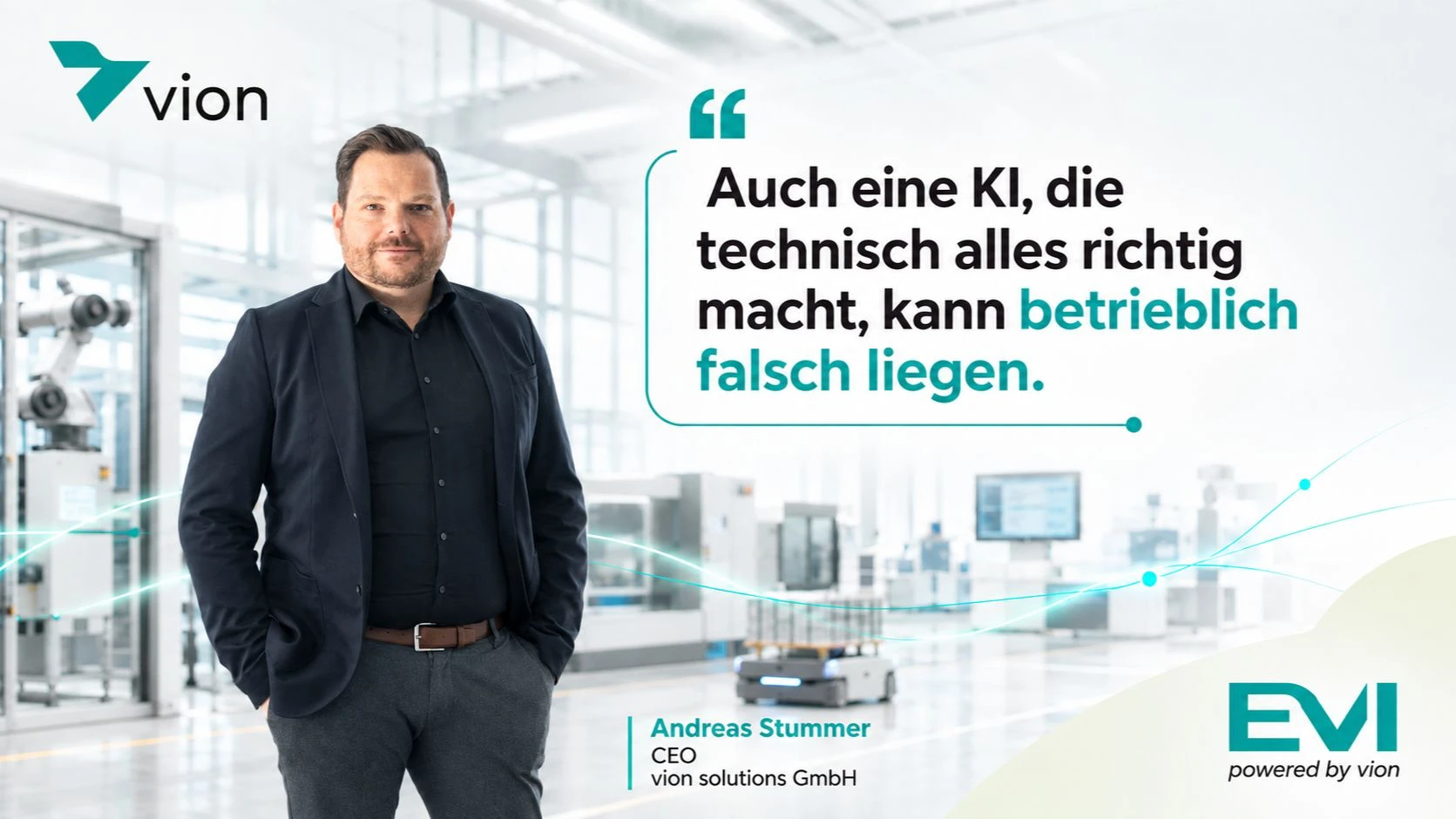
Almost two weeks ago, Anthropic introduced “Claude for Manufacturing”, an offering for using AI in industrial settings. Among other things, it covers connecting existing ERP, CAD and other enterprise systems, and supporting quality assurance, maintenance and production planning. A commentary by Andreas Stummer, CEO of vion solutions.
Humans stay in the loop, for good reason
Direct control of production equipment is not planned for now, and humans remain involved in critical decisions. In my view, that makes sense. After all, how is an AI supposed to know which decision is actually the right one in a specific production situation?
An example from practice
Take a CNC machine that needs material. An AMR is available and the AI decides to trigger the transport. A logical decision in principle. But what if the order has not been released yet, a quality inspection is still pending, or another machine has priority because of a resource bottleneck?
In this case, the AI does not even have to hallucinate. It simply lacks the operational context to assess and account for these dependencies.
Processes that have grown over decades
In many companies, production processes have grown over decades. Some of them are mapped in machine controls, ERP systems and various software solutions. On top of that come processes and decisions based on the experience of employees, which are often only sparsely documented digitally.
This becomes especially clear in hybrid manufacturing environments and in batch-size-one production.
AI needs business logic, not just data
In addition to the available data, an AI therefore needs the corresponding business logic. It has to know and account for the dependencies between orders, machines, resources and releases. How these processes interact differs from company to company, which makes it highly specific.
Orchestration as the foundation
With our EVI Operations Platform, we at vion solutions have been working on orchestrating exactly these dependencies from the very beginning. We connect people, machines, robotics and autonomous systems, and map the processes and rules that go with them.
This is an essential foundation for the future use of AI agents in production. The possible applications will keep evolving. The question, however, is whether existing production systems can provide the necessary context at all.
In my view, that will be one of the major challenges of using AI in production.
Are you also working on AI in production? Let's exchange ideas.
Book a meeting nowMore posts
View all news
General
New partnership with Dobot Robotics: Rover X1 meets EVI
vion solutions has joined the DOBOT partner network in Austria. Together we are extending the four-legged Rover X1 with LiDAR-based environment perception and autonomous navigation, and connecting it to existing workflows through EVI.
Read more
Insights
It is not the individual solution that makes the difference, but the system that connects them
People, robots, automated guided vehicles and soon humanoid robots: why automation in custom manufacturing needs a common layer that connects and orchestrates everything.
Read more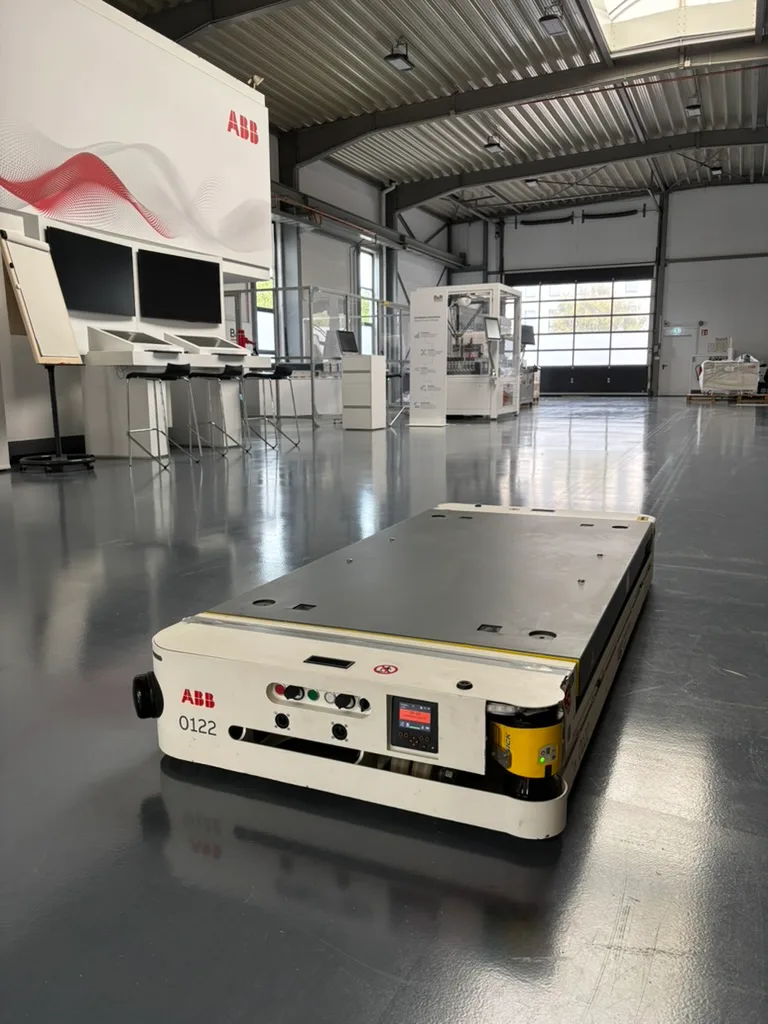
General
Visiting ABB Robotics in Friedberg
A deep dive into AMR technology, software and architecture, and into the question of how autonomous systems can be integrated even more deeply into a continuous production flow.
Read more